

Green MP Will Introduce Bill On Maximum Workplace Temperatures
Trade Unions have campaigned for this for years
Hannah Spencer, the Green MP for Gorton and Denton, is set to bring a bill before parliament aimed at establishing a maximum safe temperature for UK workplaces, as the country continues to experience more frequent and intense heatwaves.
Under the proposed legislation, an independent body would be created to recommend safe maximum temperatures for workplaces and advise on how those limits should be enforced. The move responds to long-standing criticism from unions and campaigners that, while the UK has official guidance on minimum workplace temperatures, no equivalent maximum exists — despite summers becoming markedly hotter due to climate change.
Speaking to BBC Radio 5 Live, Hannah said:
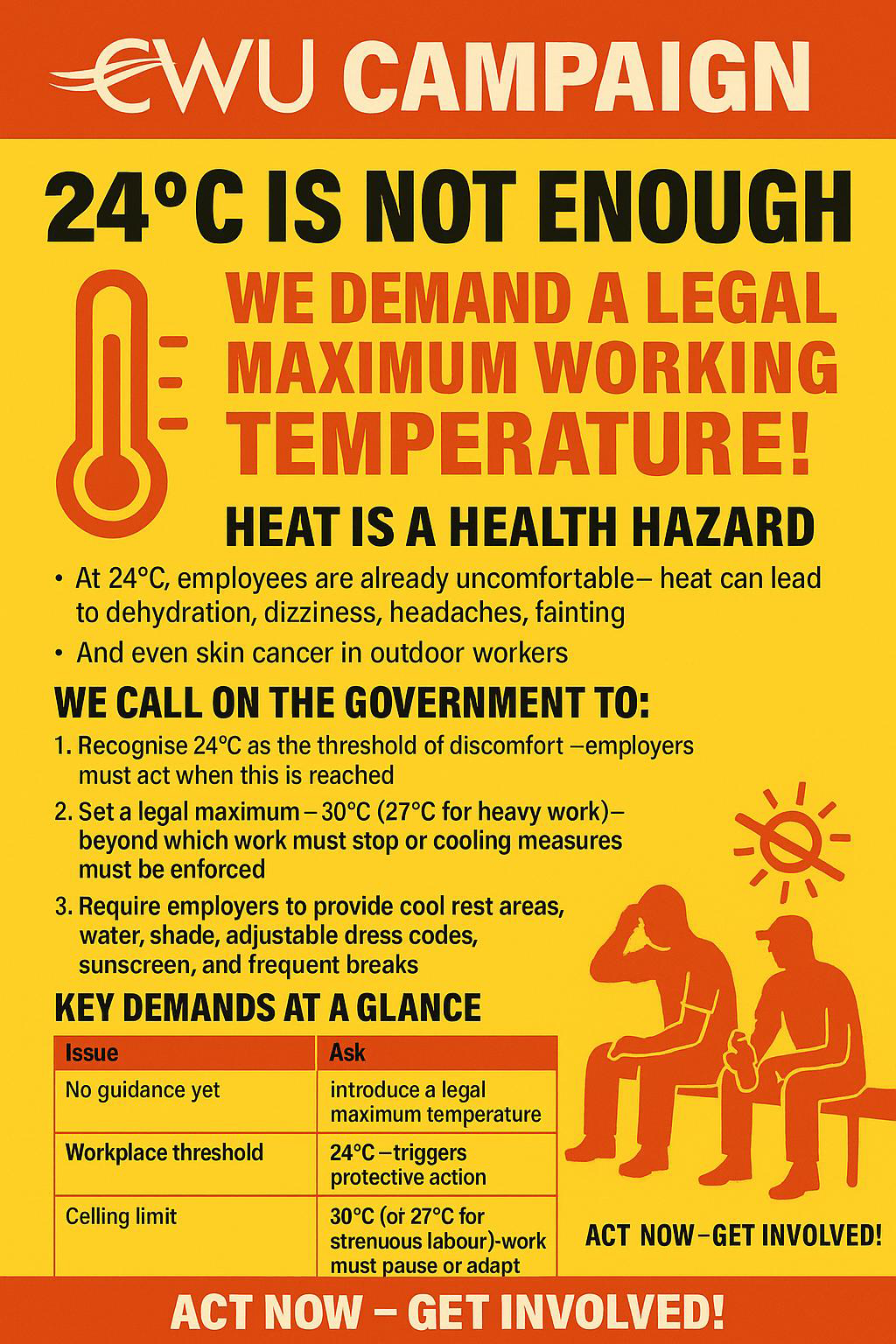
Unions including Unison, and CWU along with the TUC have previously called for a cap of 30C for general indoor work, dropping to 27C for more physically demanding roles.
The Communication Workers Union has thrown its weight behind the campaign for statutory limits. The union has been backing the TUC's push for a legal maximum indoor working temperature of 30C, or 27C for strenuous work, and has been taking part in talks with the TUC, the HSE and other unions on updating the 1992 workplace health and safety regulations to address temperature.
In April 2025, the CWU's North West Regional Committee orgnised a second Health & Safety Conference were workplace temperatures were the subject of an audience participation presentation by Heat Strike; an organisation working across stake holder organisations and the Trade union movement, highlighting the need for maximum and minimum temperatures at work.
The union's health and safety National Officer, Dave Joyce had for many years provided CWU Branches with advice on wokring in high remperatures. whilst campaigning within the TUC and with employers e.g. Royal Mail for a maximum temperature and ensuring h&S guiadance was isued by both the Union and Employers about working in heat.
Now, following Dave Joyce's retirement, CWU's National Heath and Safety Policy Adviser, Jamie McGovern has also been distributing heat-illness guidance to members, noting that the HSE records around 4,500 new skin cancer diagnoses a year linked to outdoor work as part of the case for updated protections. As part of a wider TUC week of action, union safety representatives have been given free thermometers to check conditions in their own workplaces.
You can download many of these CWU heat guidance documents from the unionsafety E-Library here
 The TUC itself has argued that formal maximum temperature rules would tackle the growing danger extreme heat poses to workers and push employers to install the cooling measures needed to keep them safe, while stressing that businesses carry primary responsibility for investing in their own adaptations, provided workplaces and working practices remain safe for staff, including those working outdoors. The organisation has also highlighted the direct health toll of extreme heat, warning that it can lead to exhaustion among workers.
The Health and Safety Executive has previously argued against a blanket maximum, noting that excessive workplace heat can stem from the nature of the work itself — such as ovens in a bakery — rather than outdoor weather conditions alone. There is currently no legal minimum temperature either, though HSE guidance recommends 16C, or 13C for strenuous work.
Hannah Spencer, a former plumber who entered parliament after winning the Gorton and Denton byelection in February, has spoken publicly about the difficult conditions faced by tradespeople during hot weather. She pointed to bus and train drivers working in overheated cabins, bakers enduring temperatures above 40C, and construction workers with no shelter from the sun, arguing that government has a responsibility to protect workers from these conditions. She also described being contacted by a constituent who had to lay tarmac on local roads in what he described as unbearable heat.
Spencer called it "absurd" that no maximum temperature guidance currently exists, noting that unions have raised this issue for years and that recent extreme heat should serve as a "wake-up call" for ministers, who she said have offered no indication of how they intend to respond to the disruption and human cost caused by the heat.
She pointed to Spain as a possible model, where maximum permitted temperatures vary depending on the type of work being done, and employees can shift their working hours during heatwaves to avoid the hottest part of the day.
The bill is reportedly expected to attract cross-party backing, with support lined up from Labour MPs Rebecca Long-Bailey, Alex Sobel and Nadia Whittome, the SNP's Graham Leadbitter, Plaid Cymru's Liz Saville Roberts, and independent MP Jeremy Corbyn.
In May, the Climate Change Committee, which advises the government on climate policy, recommended introducing maximum workplace temperature rules to protect worker safety and encourage greater use of cooling measures, though it stopped short of proposing a specific figure. Ministers have yet to formally respond to that recommendation. The government has, however, confirmed that the HSE will hold a public consultation later this year on updating its guidance, potentially including formal temperature thresholds.
The renewed political attention comes amid a record-breaking year for extreme heat: temperatures have topped 34C on nine separate days so far, surpassing the previous record of seven such days set in 1976 and 2020, while six days have seen temperatures reach 35C or higher — also a first. Scientists have said the recent heatwave would not have been possible without human-driven climate change. Forecasters expect the current hot spell across England and Wales to continue until at least Wednesday.
Source: CWU / The Guardian / Brian Coupland / BBC FaceBook
